

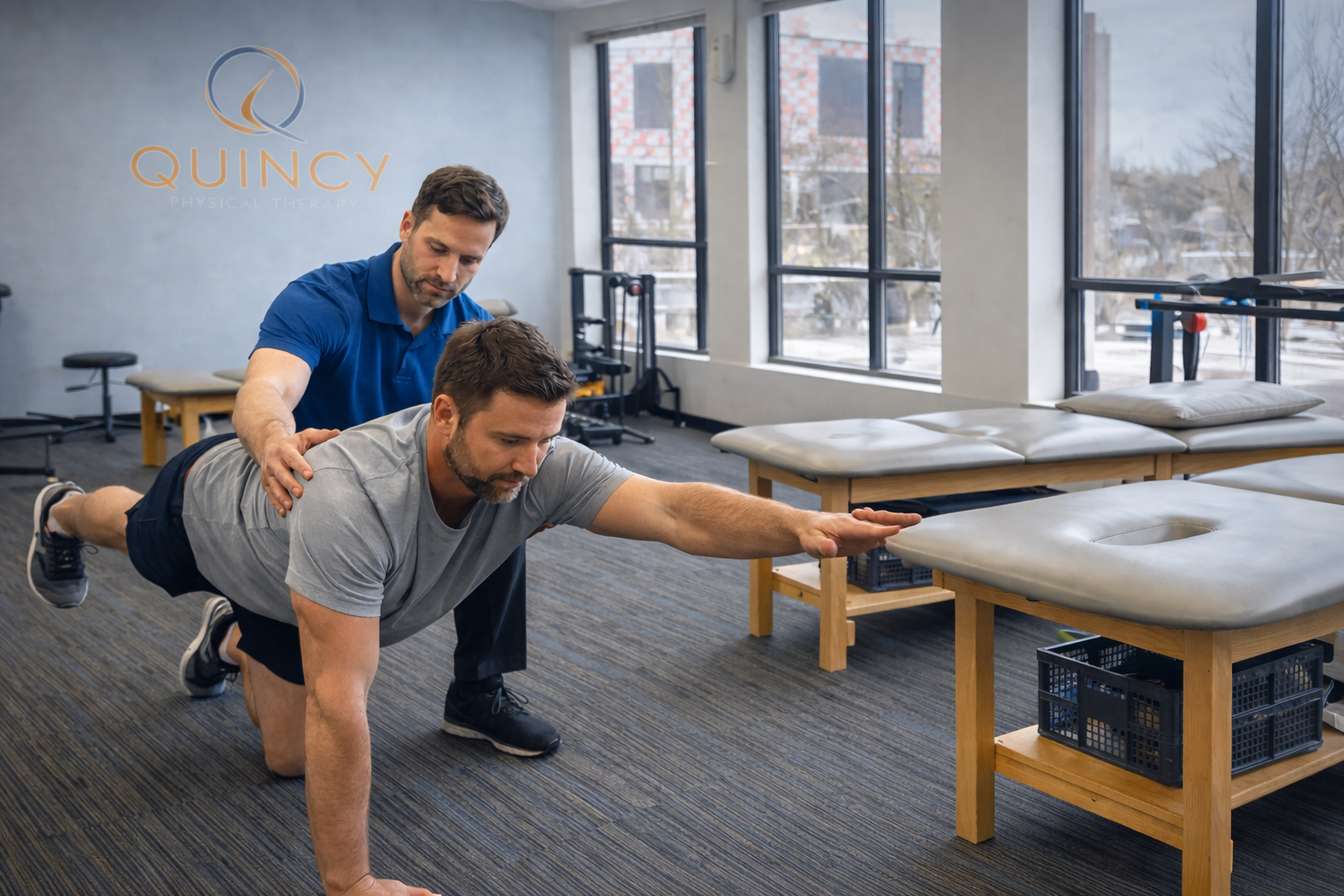
Low back pain is one of the most common reasons people seek healthcare — but what many patients (and even some providers) don’t realize is that most back pain is classified as non-specific low back pain. Understanding how common this condition is — and what that means for treatment — can completely change how we approach recovery.
At Quincy PT, we believe education is the first step toward reducing fear, improving movement, and helping people return to the life they want to live.
Let’s look at what the research actually tells us.
What Is Non-Specific Low Back Pain?
Non-specific low back pain refers to pain in the lower back that cannot be traced to a single identifiable structural cause such as fracture, infection, cancer, or significant nerve compression.
That might sound vague — but it’s actually very important.
Research shows that the majority of low back pain cases fall into this category, meaning:
-
Pain is real and impactful
-
It is rarely caused by a single structural “problem” seen on imaging
-
Recovery depends on multiple factors including movement, strength, nervous system sensitivity, lifestyle, and psychosocial influences
Modern pain science recognizes that low back pain is multidimensional, involving physical, neurological, and behavioral components.
How Common Is Low Back Pain?
The numbers are significant.
-
Approximately 619 million people worldwide live with low back pain, making it the leading cause of disability globally.
-
Lifetime prevalence estimates suggest that 60–80% of people will experience low back pain at some point.
-
At any given time, roughly 9–12% of the population may be experiencing active symptoms.
In other words, back pain is not unusual — it’s incredibly common.
When patients believe their pain is rare or uniquely severe, fear and avoidance behaviors often increase. Understanding how common low back pain is can reduce anxiety and improve recovery outcomes.
Why Is Non-Specific Low Back Pain So Prevalent?
There isn’t a single cause — and that’s exactly why it’s called non-specific.
Current research highlights several contributing factors.
Modern Lifestyle and Movement Patterns
Long periods of sitting, repetitive activities, and reduced physical activity influence back pain prevalence by affecting tissue tolerance and movement variability.
Importantly, pain is rarely caused by “bad posture” alone. Instead, it often reflects reduced adaptability and load tolerance over time.
Nervous System Sensitivity
Pain is not just about tissue damage — it’s also about how the brain interprets signals from the body.
In non-specific low back pain:
-
The nervous system may become more sensitive
-
Protective muscle guarding can increase
-
Movement may feel threatening even when structurally safe
This explains why two people with similar imaging findings can have very different pain experiences.
Psychosocial and Environmental Factors
High-level research consistently shows strong associations between back pain and:
-
Stress
-
Poor sleep
-
Fear of movement
-
Work demands
-
Emotional health
These factors do not mean pain is “in your head.” Instead, they highlight that pain is influenced by the entire human system — not just one structure.
Why Imaging Often Doesn’t Tell the Full Story
Many patients are surprised to learn that imaging findings like disc bulges or degeneration are extremely common — even in people without pain.
Structural findings do not always equal symptoms.
Focusing only on imaging can sometimes increase fear or lead to unnecessary treatments. Modern physical therapy prioritizes:
-
Functional assessment
-
Movement patterns
-
Strength and endurance
-
Pain education
Evidence-Based Treatment for Non-Specific Low Back Pain
Despite how common back pain is, the outlook is generally positive.
Research shows that most people improve with:
-
Gradual movement and activity progression
-
Targeted strengthening and mobility work
-
Education that reduces fear and promotes confidence
Avoidance of movement is one of the strongest predictors of ongoing symptoms. Staying active — within tolerable limits — is one of the most evidence-based strategies available.
Physical Therapy for Low Back Pain in Quincy MA
Many patients in Quincy and the South Shore experience non-specific low back pain related to work demands, commuting, recreational activities, or previous injuries.
Modern physical therapy focuses on restoring confidence in movement rather than simply trying to “fix” one structure.
Treatment often includes:
-
Individualized exercise progression
-
Movement retraining
-
Strength and mobility development
-
Education based on current pain science research
How Quincy PT Approaches Back Pain Treatment
At Quincy PT, we combine current research with individualized clinical assessment. See our page on Low Back Pain for extensive information.
Because non-specific low back pain is so common, we don’t treat it as a mystery — we treat it as a solvable problem.
Our goal is to help you:
-
Understand your pain
-
Move without fear
-
Build resilience and strength
-
Return to work, sport, and daily life confidently
If you’re experiencing back pain — whether it’s new or long-standing — know that you’re not alone, and effective treatment is available.
Research References
Hartvigsen J, Hancock MJ, Kongsted A, et al. What low back pain is and why we need to pay attention. The Lancet. 2018.
Foster NE, Anema JR, Cherkin D, et al. Prevention and treatment of low back pain: evidence, challenges, and promising directions. The Lancet Low Back Pain Series. 2018.
Maher C, Underwood M, Buchbinder R. Non-specific low back pain. The Lancet. 2017.
World Health Organization (WHO). Low back pain fact sheet.
Global Burden of Disease Study. Global, regional, and national burden of low back pain.
Wu A, et al. Global low back pain prevalence and years lived with disability.