

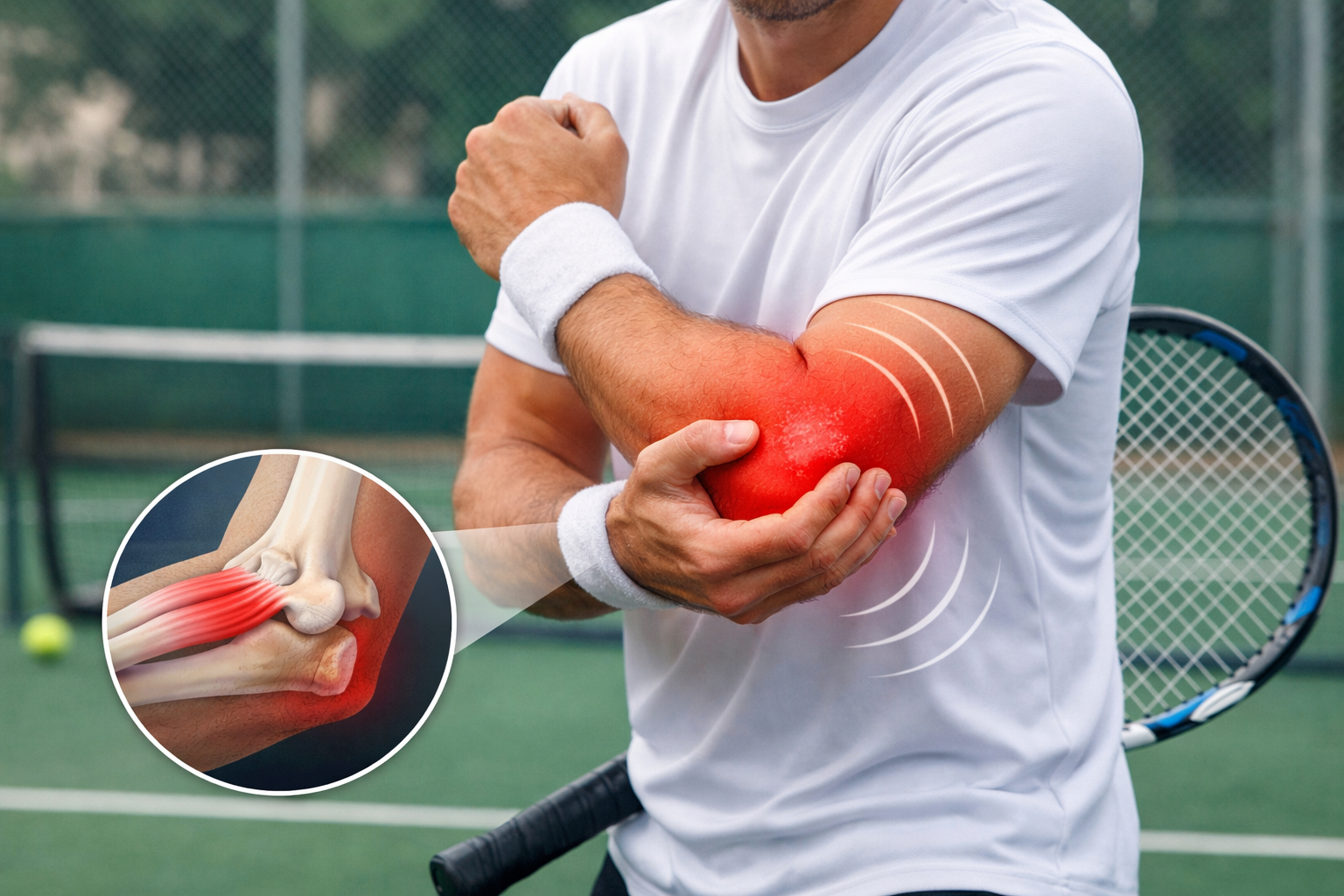
Tennis Elbow Isn’t Really an “-Itis”: The Evidence-Based Path to Recovery
Executive summary: Most “tennis elbow” is actually lateral elbow tendinopathy (LET)—a tendon loading problem, not a simple inflammation problem. The best-supported approach is progressive strengthening (loading) over time, using pain-monitoring rules and gradual return to activity, while understanding that passive treatments (massage, braces) may help symptoms but rarely “fix” the underlying capacity issue.
What tennis elbow really is
Despite the name “lateral epicondylitis,” most cases behave like tendinopathy: pain aggravated by tendon loading, with underlying tendon changes that are not primarily a classic inflammatory “tendinitis.” The 2022 clinical practice guideline explains the terminology shift: tendinitis describes an acute inflammatory response, tendinosis describes chronic degenerative tendon pathology, and modern terminology often uses tendinopathy to reflect a spectrum of tendon changes and pain mechanisms.
Inflammation can still play a role at times (for example, a flare after heavy activity), but in LET it’s often intermittent/low-grade rather than the main driver—so the long-term solution is usually gradually rebuilding tendon tolerance.


Myths vs facts
Myth: “It’s inflammation—rest and anti-inflammatories will cure it.”
Fact: Anti-inflammatories can help pain, but they don’t “rebuild” tendon capacity. A Cochrane summary found topical NSAID gel improved pain by about 1.6/10 at 4 weeks vs placebo gel, while evidence for oral NSAIDs is uncertain and they probably increase GI side effects. Use them as a short-term symptom tool while you restore strength.
Myth: “Massage breaks up the problem and fixes it.”
Fact: Hands-on care can help some people feel better short term, but it’s rarely enough alone. The 2022 guideline summarizes evidence that eccentric strengthening improved pain compared with passive approaches that included options like heat/ice/ultrasound/cross-friction massage (effect size around SMD −0.63), although the included studies had high risk of bias—so the core message remains: passive care may help, but loading is the engine of recovery.
Myth: “A brace will fix it.”
Fact: Braces/orthoses may help you do tasks with less pain, but they don’t automatically restore capacity. The BESS pathway states patients should be aware orthotics/splints may not provide benefit; the 2022 guideline notes evidence is conflicting and suggests orthoses mainly as a short-term option for high irritability when function is difficult.
Myth: “A cortisone shot cures tennis elbow.”
Fact: Steroid injections often help quickly, but high-quality evidence shows worse outcomes later. In a landmark randomized trial, corticosteroid injection led to worse 1-year recovery (83% vs 96%) and much higher recurrence (54% vs 12%) than placebo injection. The BESS pathway gives strong guidance that steroid injections should not be used for LET.
Myth: “PRP is proven to heal the tendon.”
Fact: A 2021 Cochrane review found little to no clinically important benefit versus placebo injection (e.g., pain difference about 0.16/10 at 3 months), and concluded the costs/risks aren’t justified given lack of benefit. NICE notes autologous blood injection for tendinopathy appears safe but has uncertainty about how well it works.
The plan that works best: progressive loading
The 2022 guideline recommends resisted wrist extensor exercise—isometric, concentric, and/or eccentric—and supports a phased approach to reintroduce stress and restore strength/endurance for work and sport.
A key principle is progress without flaring: suggested dosing for isotonic/eccentric strengthening is often three sets of fifteen reps for about six to twelve weeks, with loads that do not exacerbate symptoms, progressing from isometric → isotonic → eccentric “as tolerated.”
If you want a research-backed “why,” the guideline summarizes a randomized trial where a simple daily home isometric wrist extensor program (eight weeks) improved pain and disability versus “wait and see” (pain effect about SMD −0.80, disability SMD −0.92).
Pain-monitoring in plain language: LET management should match irritability. One practical guideline framework categorizes pain as mild (≤3/10), moderate (4–6/10), or severe (≥7/10). If you’re in the severe range or your pain spreads or feels nerve-like, get assessed before pushing loading.
Home Exercise Starter
These are intentionally simple “starter” options. Adjust based on symptom irritability and next-day response, and consider professional guidance if you’re unsure.
Wrist extensor isometric (start here if very irritable)
Forearm supported, palm down. Press the back of your hand gently up into your other hand (minimal movement). Work at a tolerable effort (often “moderate” and steady), and build gradually.
Wrist extension strengthening (isotonic → eccentric)
Forearm supported, palm down holding a light weight. Lift up and lower slowly. Typical guideline dosing for isotonic/eccentric strengthening: three sets of fifteen, progressed over six to twelve weeks, without symptom exacerbation.
Grip or forearm support exercise (tendon-friendly functional loading)
Squeeze a towel/ball or use a light resistance band for forearm work only if it stays tolerable and helps you build capacity for daily tasks (gripping often provokes LET). If gripping spikes pain, scale back and prioritize wrist extensor loading first.
When to seek further care and special cautions
Seek a PT or medical assessment if pain is severe, worsening, spreading, associated with numbness/tingling, or if you’re not improving after a structured loading plan. Imaging is typically reserved for diagnostic uncertainty rather than routine cases.
Caution flags for common “next-step” treatments:
- Diabetes: corticosteroid injections can raise blood glucose, especially in the first 24–72 hours, so monitoring/planning is important.
- Blood thinners (anticoagulants): injections and some needling procedures require extra precautions and individualized planning (for example, warfarin often requires an INR check before proceeding in some protocols).
Quick FAQ
How long does it take to get better?
Many people improve within weeks to a few months, but symptoms can last longer in some cases; a common strengthening window is six to twelve weeks before judging trend.
Should I stop all activity?
Usually no—complete rest often deconditions the tendon. The goal is to modify painful loads and progressively rebuild tolerance.
Do I need a shot?
Often no. Steroid injections can backfire long term; PRP/autologous blood has not shown meaningful benefit over placebo in the best evidence.
Call to action
If your elbow pain is limiting work, lifting, sports, or sleep—or you’re unsure how to progress exercises without flaring—contact our clinic. We’ll build a step-by-step loading plan matched to your pain irritability, daily demands, and goals.
References
- Lucado et al. Lateral Elbow Pain and Muscle Function Impairments: Clinical Practice Guidelines (2022).
- British Elbow and Shoulder Society Patient Care Pathway: Tennis Elbow (2023).
- Cochrane summary: NSAIDs for treating tennis elbow pain in adults (updated summary page 2022).
- Cochrane review: Autologous blood/PRP injection therapy for lateral elbow pain (Karjalainen et al., 2021).
- Coombes et al. Corticosteroid injection vs placebo ± physiotherapy randomized trial (2013).
- National Institute for Health and Care Excellence HealthTech Guidance: Autologous blood injection for tendinopathy (HTG299; patient information PDF).
- NHS patient leaflet: Post-corticosteroid injection advice for people with diabetes (hyperglycemia risk).
- NHS guidance: Oral anticoagulants and joint/soft tissue injections (precautions; warfarin INR guidance in some protocols).