

How Long Should You Rest Between Sets? Proper Rest and Optimal Strength Training Frequency
If you lift weights, you have probably wondered whether shorter rest is “better,” whether you should train each muscle once or several times per week, and how to tell the difference between normal fatigue and doing too much. Current research gives a pretty clear big picture: longer rest usually helps strength more than rushing between sets, muscle growth depends more on good weekly training volume than on keeping rest painfully short, and training all major muscle groups at least twice per week is a strong baseline for most adults. Strength training frequency can be more important than how hard the workout actually is.
Key takeaways
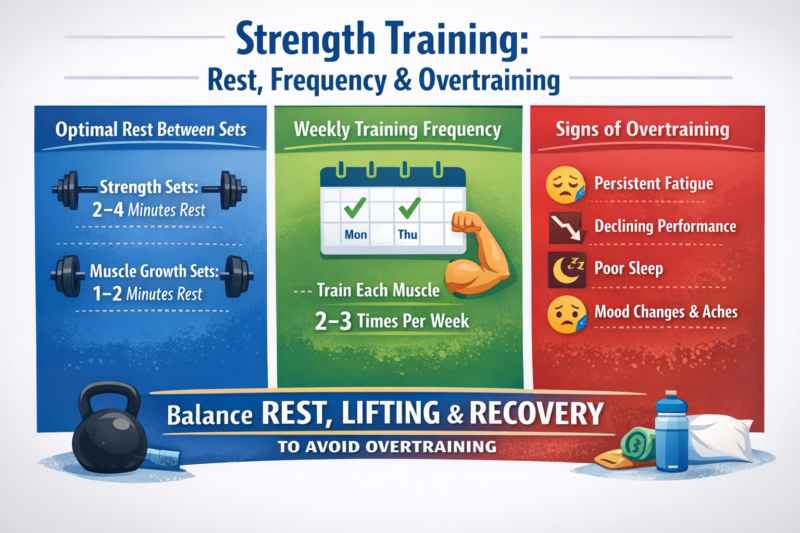
- For heavy strength work, rest at least 2 minutes between hard sets. Many people do best with about 2 to 4 minutes on big lifts like squats, deadlifts, presses, and rows. [1][3]
- For muscle growth, resting more than 60 seconds appears slightly better than very short rest. On simple accessory lifts, 1 to 2 minutes is often enough. On harder compound lifts, 2 or more minutes may help you keep rep quality higher. [2][3]
- For most adults, training each major muscle group at least 2 times per week is a practical, evidence-based target. Around 10 weekly sets per muscle group is a useful starting point for hypertrophy. [1][4][5]
- True overtraining syndrome is not the same as being sore for a day or two. It is a longer-lasting state of underperformance and poor recovery, and it is seen most often in athletes with high loads and not enough recovery. [6]
What “rest between sets” actually means
Rest between sets is the recovery time you take before starting your next set of the same or a different exercise. That pause matters because it affects how much force you can produce, how many reps you can complete, and how much good-quality training you can accumulate across the whole workout. Short rest feels hard, but “feels hard” is not always the same thing as “works best.” [1][2][3]
What current research says about rest between sets
For strength, longer rest wins more often. A systematic review found that while strength can improve even with short rest, longer intervals, especially more than 2 minutes, appear more helpful for maximizing strength gains in trained lifters. That makes sense: if you recover better, you can use more load and do more high-quality reps on later sets. [3]
For muscle growth, the story is a little more nuanced. A 2024 systematic review and Bayesian meta-analysis found a small hypertrophy benefit for resting more than 60 seconds, but it was less clear that going much longer than that always adds more benefit. In real life, that means you do not need to race the clock. You want enough rest to keep the next set productive. [2]
A practical way to program it:
- Heavy compound lifts for strength: about 2 to 4 minutes between hard sets. [1][3]
- Accessory lifts for muscle growth: about 1 to 2 minutes often works well. [2]
- Big lifts done for hypertrophy: often closer to 2 minutes or a bit more, especially if shorter rest makes your reps crash. [2][3]
A simple rule: if your rest is so short that your technique falls apart or your reps drop sharply from set to set, it is probably too short for your goal.
How often should you train each muscle group per week?
This is where many people expect a perfect number, but the evidence is better at giving a range than a single magic answer.
The newest ACSM update recommends training all major muscle groups at least twice per week, and highlights roughly 10 weekly sets per muscle group as a useful hypertrophy target. That is a strong, simple baseline for most adults. [1]
At the same time, research suggests that frequency matters less when total weekly volume is matched. In other words, 10 hard weekly sets for chest can work whether you do them in one long session or split them across two or three days. But for many people, splitting that volume over 2 to 3 sessions per week makes it easier to keep the sets stronger, the form cleaner, and the soreness more manageable. [4][5]
So what is “optimal” for most people?
- 2 times per week per muscle group: best-supported default for general strength and muscle gain. [1][5]
- 3 times per week per muscle group: often helpful if you are advanced, want more practice on big lifts, or need to spread out higher weekly volume. [1][4]
- 1 time per week per muscle group: can still work, especially if weekly volume is high enough, but it is usually not the most practical setup for quality or recovery. [5]
For most adults, a good weekly setup looks like full-body training 2 to 3 days per week, or an upper/lower split done 4 days per week.
What counts as overtraining?
Many people say “I’m overtraining” when they really mean, “I’m tired and sore.” Those are not the same thing.
Normal training causes short-term fatigue. That is expected. A harder training week may also cause a temporary dip in performance. But overtraining syndrome is a much bigger problem: persistent fatigue, worse performance, poor recovery, mood changes, and other symptoms that do not bounce back with usual rest. It is seen most often in high-load athletes and military populations, not in the average person who had one tough leg day. [6]
A more useful way to think about it is a recovery spectrum:
- Normal training fatigue: tired for a day or two, then you recover.
- Short-term overreaching: performance dips briefly, then improves after extra recovery. [6]
- Non-functional overreaching / overtraining syndrome: performance stays down, recovery lags, and symptoms spread beyond normal soreness. [6]
Signs you may be under-recovered
Watch for patterns, not just one bad workout.
- Your numbers are dropping for 2 or more weeks, even though you are trying hard. [6]
- You feel unusually heavy, flat, or unmotivated every session. [6]
- Sleep is worse, not better, despite feeling tired. [6]
- You are more irritable, foggy, or anxious. [6]
- Nagging aches, overuse pain, or frequent illnesses keep piling up. [6]
What helps
The best recovery plan is usually not “do less forever.” It is “dose training better.”
Start by spacing hard work more intelligently. Give big lifts enough rest between sets. Spread weekly volume across 2 to 3 sessions per muscle group if one day is leaving you wiped out. Keep at least 1 to 2 lower-stress or off days each week. Make sure sleep and food match your training load. A tougher program with poor sleep and too little fuel is much more likely to backfire. [1][4][6]
If pain, stiffness, or a previous injury keeps interrupting your progress, a plan built around Strength Training Physical Therapy or Orthopedic & Sports Physical Therapy can help you adjust exercise selection, loading, and recovery instead of guessing.
Try-this-today checklist
- Rest 2 to 4 minutes on your hardest strength sets. [1][3]
- Rest 1 to 2 minutes on smaller accessory lifts, unless performance drops off fast. [2]
- Train each muscle group at least twice per week. [1]
- Aim for roughly 10 weekly sets per muscle group if muscle growth is a goal. [1]
- If one session leaves you wrecked, split the same weekly work across more days. [4][5]
- If performance is sliding for weeks, do not just push harder. Step back and look at total load, sleep, stress, and nutrition. [6]
What to avoid
- Treating short rest as automatically “more intense, so better.” [2][3]
- Trying to smash all your weekly work for one muscle into one marathon session. [4][5]
- Adding sets, days, and intensity all at once. [6]
- Ignoring warning signs like poor sleep, falling performance, and persistent joint or tendon pain. [6]
When to seek urgent care
Seek urgent medical care if training symptoms come with chest pain, fainting, severe shortness of breath, a racing or irregular heartbeat, dark urine, or severe swelling and weakness after exercise. Those are not typical signs of ordinary training fatigue.
When to see a PT
See a physical therapist if lifting keeps flaring up back, neck, shoulder, knee, or tendon pain, or if you are stuck in a cycle of soreness, form changes, and stalled progress. If you are not sure whether your problem is “normal gym fatigue” or something that needs a closer look, a Free Discovery Visit can help you sort out next steps.
FAQ
Is 30 seconds of rest ever okay?
It can be fine for lighter accessory work, circuits, or conditioning. It is usually not the best choice for maximizing strength on heavy lifts. [2][3]
Can I train the same muscle 3 times per week?
Yes. That can work very well, especially if you are splitting up weekly volume so each session stays high quality. [1][4]
Is once per week enough?
It can be enough to make progress, but for most adults it is not the clearest “sweet spot.” Hitting muscle groups twice per week during your training will be more optimal. As we always say though, once is better than none! [1][5]
How do I know if I am overtraining or just sore?
Soreness is local to the muscle groups you worked and usually improves in a few days. Overtraining or serious under-recovery looks more like persistent poor performance, poor sleep, low motivation, mood changes, and trouble bouncing back week after week. [6]
Why Quincy Physical Therapy
Quincy Physical Therapy is a spine-focused orthopedic clinic, but our approach goes well beyond “just rest it.” We look at how you move, how you load tissue, how your program is set up, and how to build strength in a way that matches your goals, recovery, and history. That is especially useful when pain, technique issues, or repeated flare-ups are getting in the way of consistent training.
Schedule an evaluation if you want help building a strength plan that challenges you without constantly knocking you backward.
References
- Currier BS, Phillips SM, D’Souza AC, et al. American College of Sports Medicine Position Stand: Resistance Training Prescription for Muscle Function, Hypertrophy, and Physical Performance in Healthy Adults: An Overview of Reviews. 2026.
- Singer A, Wolf M, Schoenfeld BJ, et al. Give it a rest: a systematic review with Bayesian meta-analysis on the effect of inter-set rest interval duration on muscle hypertrophy. 2024.
- Grgic J, Schoenfeld BJ, Skrepnik M, Davies TB, Mikulic P. Effects of Rest Interval Duration in Resistance Training on Measures of Muscular Strength: A Systematic Review. 2018.
- Currier BS, McLeod JC, Banfield L, et al. Resistance training prescription for muscle strength and hypertrophy in healthy adults: a systematic review and Bayesian network meta-analysis. 2023.
- Schoenfeld BJ, Grgic J, Krieger J. How many times per week should a muscle be trained to maximize muscle hypertrophy? A systematic review and meta-analysis of studies examining the effects of resistance training frequency. 2019.
- Fiala O, Hanzlova M, Holmannova D, et al. Beyond physical exhaustion: Understanding overtraining syndrome through the lens of molecular mechanisms and clinical manifestation. 2025.