

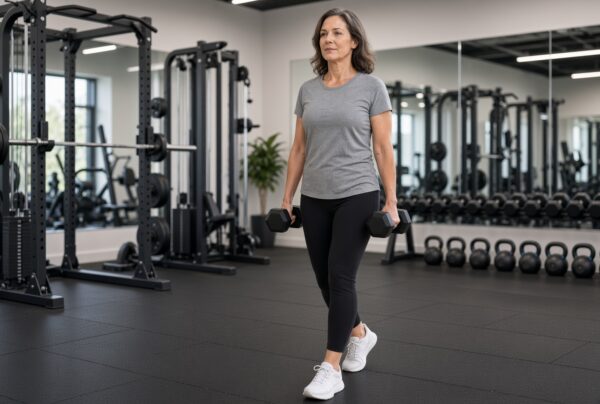
Loaded carries are one of the simplest ways to build a stronger, more resilient back. Most “back exercise” lists stop at planks, bird dogs, and machines. Those can help, but they miss something you do every day: walk while holding weight. Loaded carries train that exact skill. At Quincy Physical Therapy, we use loaded carries because they build trunk control, grip, and hip strength in a position that looks like real life. If your goal is a back that handles groceries, kids, yard work, and the gym, loaded carries belong in the plan.
Key takeaways
- Loaded carries train your trunk while you move, not just while you hold still.
- Farmer carries (weight in both hands), suitcase carries (weight in one hand), and front-rack carries (weight at the shoulders) each challenge the back in a slightly different way.
- Walking with a load often creates more trunk muscle work than standing and holding the same weight. [1]
- Keep the weight close, stand tall, and take short, controlled steps. Distance and control matter more than max weight.
- Start lighter than you think, especially after a flare. Carries should feel like work, not like a new injury.
- Pair carries with whole-body strength, not as a standalone “core miracle.”
Why loaded carries help your back
Your back does not only work when you lie on a table or do a crunch. It works when you pick something up, stand tall, and walk with it.
That is what loaded carries train:
- Trunk stiffness you can use. Your side and deep trunk muscles work to keep you from tipping, twisting, or folding as each foot leaves the ground. [2,3]
- Hip and glute support. Each step is a single-leg challenge. Your hips have to keep the pelvis steady so the low back does not do all the work. [2]
- Upright loading. Compared with a heavy hinge off the floor, a well-set carry often keeps the trunk more vertical. That can be a useful way to load the system when a deep deadlift still feels like too much. [4]
- Real-life transfer. Groceries, a suitcase, a laundry basket, a toddler, and a toolbox are all carries. Training the pattern makes daily tasks feel less threatening.
Carries are not a replacement for a full plan. They work best as one piece of strength training for low back pain that also includes hips, legs, and upper back.
The three carries worth learning
1. Farmer carry (weight in both hands)
Hold a dumbbell, kettlebell, or even two even grocery bags at your sides. Walk.
Best for: first exposure, balanced loading, grip, and posture.
Why it helps: both sides are loaded, so the demand is more even. Research comparing walking carries with matched static holds found higher activation in the low back and abdominal muscles when you actually walk. [1]
Coaching cues
- Stand tall. Ribs stacked over pelvis.
- Soften the knees slightly. Do not lock them.
- Pack the shoulders down. Do not shrug the weights up to your ears.
- Look ahead, not at your feet.
- Take short steps. If you are waddling or leaning, the load is too heavy.
2. Suitcase carry (weight in one hand)
Hold the load on one side only. Walk without leaning into it or away from it.
Best for: side-trunk strength and the “one grocery bag, one kid” problem.
Why it helps: one-sided carries make the opposite-side trunk muscles work harder to keep you upright. The lateral abdominal wall and deep side-trunk muscles help stiffen the pelvis so it does not drop toward the swing leg. [2,3]
Important: a suitcase carry is not the same demand as splitting that weight into two hands. One heavy bag creates more side-bending challenge than two lighter ones. That is useful in training. It is also why you should start lighter on this variation.
Coaching cues
- Pretend you are walking through a narrow hallway. Do not lean.
- Keep both shoulders level.
- Do not hike the loaded hip.
- Switch sides every set or every walk.
3. Front-rack carry (weight at the shoulders)
Hold one or two kettlebells (or a sandbag) at the front of your shoulders. Elbows in. Walk.
Best for: upright posture, breathing under load, and people who already tolerate side carries well.
Why it helps: the load sits closer to your center and asks your trunk to resist folding forward. It also trains the upper back to hold position, which matters for spine-friendly lifting.
Coaching cues
- Lift the chest without flaring the ribs.
- Keep the elbows in. Do not let the weights pull you into a slouch.
- Breathe. If you cannot breathe, the load is too heavy or the rack position is too sloppy.
- Skip this variation during an irritable flare if holding weight at the shoulders spikes symptoms.
How to do loaded carries well
Setup
- Choose a load you can pick up with a small hip hinge, not a rounded yank off the floor.
- Stand all the way up first. Get tall before you walk.
- Brace gently, like you are about to be lightly poked in the stomach. This is not a max breath-hold.
- Walk 20–40 feet, or 20–30 seconds. Turn carefully. Set the weight down with the same control you used to pick it up.
A simple starting point
| Level | Variation | Load guide | Dose |
|---|---|---|---|
| Beginner / irritable back | Farmer carry | Light dumbbells, kettlebells, or grocery bags | 3–4 walks of 20–30 seconds |
| Intermediate | Farmer + suitcase | Suitcase at about half the total farmer load | 3 farmer walks + 2 suitcase walks each side |
| Later progression | Front-rack or heavier farmer | Add load only if posture stays tall | 4–6 total walks, 20–40 seconds |
Do carries 1–3 days per week. They fit well at the end of a session or as a short stand-alone set on a walk day.
A useful rule: you should finish looking like you could do one more walk with the same posture. If the last 10 feet turn into a lean, a shrug, or a shuffle, cut the load or the distance.
A sample 10-minute carry finisher
Use this after your main strength work, or on a day when you want something simple.
- Farmer carry — 3 x 20–30 seconds. Rest 45–60 seconds.
- Suitcase carry — 2 x 20 seconds each side. Rest as needed.
- Optional front-rack carry — 2 x 20 seconds, lighter than the farmer sets.
Home option: two shopping bags for farmer carries, one heavier bag for suitcase carries. The pattern matters more than fancy equipment.
Pain rules
Use the same traffic-light approach we use in clinic:
- Green: mild effort, symptoms stay the same or settle within 24 hours. Keep going.
- Yellow: symptoms rise a little during the walk but calm quickly after. Keep the load, shorten the distance, and clean up your posture.
- Red: sharp, spreading, or worsening leg symptoms, new numbness/tingling, or pain that stays clearly worse the next day. Stop that variation and get it checked.
Carries should not feel like you are “pushing through” a flare. They should feel like you are teaching your back to do a normal job with better control.
What to avoid
- Starting with a heavy suitcase carry because it looks more “core.”
- Holding your breath the whole walk.
- Letting one shoulder dump toward the weight.
- Turning with a twist while the load is still in your hand. Stop, turn your feet, then go.
- Making carries your only back training. You still need hips, legs, and a smart return to lifting.
- Jumping load every session. Add a little distance first, then a little weight.
When loaded carries are a great fit
- You can walk comfortably, but carrying groceries or a laundry basket bothers you.
- Planks feel okay, but real-life tasks still feel unstable.
- You are rebuilding after a back flare and need a way to load the trunk without a heavy deadlift yet.
- You already lift and want a simple way to train grip, posture, and side-trunk strength.
When to see a physical therapist
See a PT if:
- Back or leg symptoms last more than a couple of weeks
- Pain keeps returning every time you carry or lift
- You feel weak, off-balance, or unsure which variation is safe
- You want a plan that progresses from carries into squats, hinges, and gym loading
Get urgent medical care for loss of bowel or bladder control, progressive leg weakness, numbness in the groin/saddle area, fever with back pain, or back pain after a major trauma.
A good plan is not “do carries forever.” It is using carries to rebuild confidence, then progressing into a full strength training and performance program so your back has capacity for the life you actually live.
FAQ
Are loaded carries safe if I have low back pain?
Often yes, if the load is light, the distance is short, and your symptoms stay stable. Many people with nonspecific low back pain do well with gradual strength and movement. [5] Start with farmer carries. Save heavier suitcase and front-rack work for later.
Which carry is best for my back?
There is no single best carry. Farmer carries are usually the best first option. Suitcase carries add a useful side-stability challenge. Front-rack carries add upright posture and breathing work. The best one is the one you can do tall, controlled, and repeatable.
How heavy should I go?
Heavy enough that your trunk and grip work, light enough that you do not lean, shrug, or shuffle. For many adults, that is a pair of modest dumbbells or kettlebells at first—not a max-effort strongman walk.
Can I do these at home?
Yes. Two grocery bags, a backpack held at your side, or a single kettlebell is enough to learn the pattern. Home carries count.
Do carries replace deadlifts and rows?
No. Carries build support and work capacity. Hinges, squats, and rows still build the strength you need for picking things up and pulling. Use carries with those lifts, not instead of them.
How soon will my back feel more resilient?
Some people notice daily carrying tasks feel easier within a few weeks. Lasting change comes from consistent loading, not one heroic walk. Think in terms of 4–8 weeks of steady practice.
Why Quincy Physical Therapy
At Quincy Physical Therapy, we do not treat loaded carries as a trend. We use them the same way we use other strength tools: matched to your symptoms, your capacity, and the tasks you care about. One-on-one care means we can watch your walk, clean up the setup, and progress you from a light farmer carry to the lifting and daily activity you want back.
If carrying groceries, kids, or gym weights still bothers your back, we can help you build a plan that feels safe and actually gets stronger.
References
- Ellestad SH, et al. The Quantification of Muscle Activation During the Loaded Carry Movement Pattern. Int J Exerc Sci. 2024;17(4).
- Taylor J, Reed M. Increase Hip and Trunk Stability with Loaded Carries for Injury Prevention, Rehabilitation, and Performance. NSCA Coach. 2020;7(3).
- McGill SM, McDermott A, Fenwick CM. Comparison of Different Strongman Events: Trunk Muscle Activation and Lumbar Spine Motion, Load, and Stiffness. J Strength Cond Res. 2009;23(4):1148-1161.
- Winwood PW, Cronin JB, Brown SR, Keogh JWL. A Biomechanical Analysis of the Farmers Walk, and Comparison with the Deadlift and Unloaded Walk. Int J Sports Sci Coach. 2014;9(5):1127-1141.
- George SZ, Fritz JM, Silfies SP, et al. Interventions for the Management of Acute and Chronic Low Back Pain: Revision 2021. J Orthop Sports Phys Ther. 2021;51(11):CPG1-CPG60.