

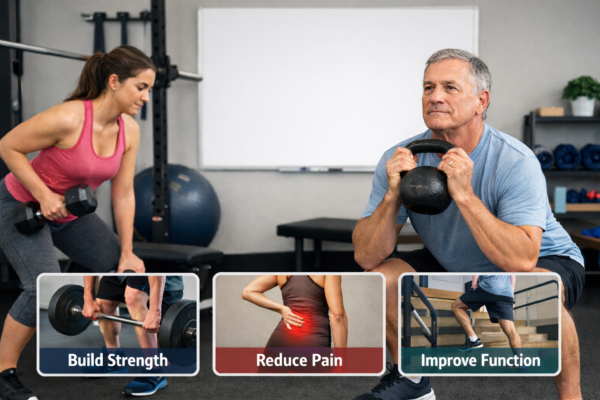
Why Strength Training Matters for Pain and Function
When people are in pain, they often stop loading the painful area. That makes sense at first. But over time, doing less can lead to more weakness, lower confidence, and more trouble with everyday tasks like climbing stairs, carrying groceries, getting off the floor, or playing with your kids.
That is where strength training for pain and function can help.
Done the right way, strength training may reduce pain, improve mobility, and help you get back to activities that matter. It is not about “pushing through” pain or lifting as heavy as possible. It is about giving your body the right amount of challenge, then building up safely over time. Research supports resistance training as a useful tool for improving pain and function in many musculoskeletal conditions, including low back pain and osteoarthritis.[1–4]
Key takeaways
-
Strength training can help improve pain, function, and confidence with movement.[1–4]
-
You do not need to start heavy for it to work.
-
A “good” starting intensity is one that feels challenging but still controlled.
-
Mild soreness is common. Sharp, worsening, or lingering pain is a sign to adjust.
-
Progress works best when it is gradual, consistent, and matched to your current ability.
What strength training actually does
Strength training is exercise that asks your muscles to work against resistance. That resistance may come from body weight, bands, dumbbells, kettlebells, machines, or even daily tasks like carrying and lifting.
For people with pain, strength training is not only about building bigger muscles. It may help by:
-
improving the ability of muscles and tendons to handle load
-
supporting joints during daily activity
-
improving balance, walking, stair climbing, and getting up from a chair
-
reducing fear of movement
-
building confidence that your body can do more again
In simple terms: stronger tissues often tolerate life better.
This is one reason strength work is commonly part of rehab in Orthopedic & Sports Rehab, Low Back Pain and Chronic Pain. It helps connect pain relief with real-world function, not just symptom control.
Why it matters for pain
Pain is complex. It is influenced by tissues, stress, sleep, past experiences, activity level, and how sensitive the nervous system feels at the time. That means pain is not always a direct measure of damage.
Strength training may help calm pain by improving tissue capacity and by gradually showing the nervous system that movement is safe again. This is sometimes called graded exposure. Instead of avoiding a movement forever, you reintroduce it in a way your body can tolerate.
For example:
-
A sit-to-stand may be the first step before squats
-
A light carry may come before lifting heavier groceries
-
A bridge may come before deadlifts
-
A short walk may come before hiking or running
That progression matters. The goal is not to “win” a workout. The goal is to build tolerance.
Why it matters for function
Pain relief is helpful, but function is usually what people care about most. They want to walk farther, work longer, sleep better, return to the gym, or feel less limited.
Strength training can improve function because daily life is full of small strength demands. Standing up, reaching overhead, getting in and out of the car, pushing a stroller, and climbing stairs all require force production. If those tasks feel hard, targeted strengthening may help make them easier.[1–4]
This is especially important with back pain, knee pain, hip pain, and after periods of inactivity. In many cases, exercise does not need to be perfect to be helpful. It needs to be consistent, appropriate, and progressed over time.[2–4]
What is the right intensity?
This is one of the most common questions.
A helpful way to think about intensity is effort, not just weight. Two people may use very different loads and still train at the same effort level.
A simple rule:
Start with an exercise that feels like moderate effort and leaves you with about 2 to 4 reps “in reserve.”
That means you finish a set feeling like:
-
“I probably could have done a few more with good form”
-
not “That was way too easy”
-
and not “I barely survived that”
A practical starting point
For many adults with pain, a good starting dose is:
-
2 to 3 sets
-
6 to 12 reps
-
2 to 3 days per week
-
effort around 5 to 7 out of 10
That may look like:
-
bodyweight sit-to-stands
-
split squats with support
-
band rows
-
step-ups
-
bridges
-
carries
-
machine-based leg press, row, or chest press
Heavier loads can be useful too, but they are not the only way to get stronger. Research and professional guidelines support a range of loads and rep ranges, as long as the exercise is performed with enough effort and progressed appropriately.[1,5]
How to progress strength training safely
Safe progression is usually slower than social media makes it look. That is okay. Good rehab training is repeatable.
Use the “2-for-2” idea
If you can do 2 extra reps above your goal on the last set for 2 sessions in a row, it may be time to make the exercise a little harder.[5]
You can progress by changing just one variable at a time:
-
add a small amount of weight
-
add 1 to 2 reps
-
add one set
-
slow the lowering phase
-
increase range of motion
-
reduce hand support
-
move from stable to less stable positions
-
move from double-leg to single-leg variations
Keep pain response in the “acceptable” zone
A useful guide:
-
0 to 3 out of 10 pain during exercise: usually acceptable
-
4 to 5 out of 10: may be okay if it settles quickly and does not spike later
-
sharp, escalating, limping, or next-day flare that lasts: back off and adjust
It is often better to train a little under your limit and come back consistently than to overdo it and need several days to recover.
Watch the 24-hour response
Your body’s response later that day and the next morning matters.
Green light:
-
mild soreness
-
temporary increase in symptoms that settles within 24 hours
-
normal movement the next day
Yellow light:
-
moderate flare that changes how you move
-
symptoms that linger more than 24 hours
Red light:
-
severe pain
-
giving way, marked swelling, numbness, or weakness that is new
-
symptoms that are clearly worsening
Try-this-today checklist
-
Pick 3 to 5 exercises that match real-life goals
-
Start with a load that feels like a 5 to 7 out of 10 effort
-
Perform 2 to 3 sets of 6 to 12 reps
-
Rest 1 to 2 minutes between sets
-
Train 2 to 3 times per week
-
Repeat for 2 weeks before making big changes
-
Progress only one variable at a time
What to avoid
-
jumping from rest straight into high-volume training
-
adding weight every session no matter how you feel
-
using pain alone as the only guide
-
copying someone else’s program without adjusting for your current capacity
-
thinking soreness means damage
-
thinking no pain means no progress
When to seek urgent care
Strength training should not cause red-flag symptoms. Seek urgent medical care if pain comes with:
-
loss of bowel or bladder control
-
numbness in the groin or saddle area
-
sudden major weakness
-
chest pain, shortness of breath, or fainting
-
fever, unexplained weight loss, or severe night pain
-
major trauma or suspected fracture
When to see a PT
It may help to see a PT if:
-
pain is stopping you from exercising
-
you are not sure what intensity is safe
-
you keep flaring up when you try to progress
-
you want a plan tied to your specific goals
-
you are returning after surgery, injury, or a long break
Our Strength Training Physical Therapy approach focuses on building capacity step by step so exercise feels productive, not punishing.
FAQ
Can strength training make pain worse?
It can temporarily increase symptoms, especially at the start. That does not always mean harm. The key is whether symptoms stay in a tolerable range and settle within about 24 hours.
Do I have to lift heavy to get benefits?
No. Moderate loads can still help a lot, especially early on. The best program is the one you can do consistently with good form and recovery.[5]
How many days per week should I train?
For most adults, 2 to 3 days per week is a practical place to start. WHO guidelines also recommend muscle-strengthening activities at least 2 days per week.[6]
What if I have arthritis or chronic back pain?
Strength training is often helpful for both, with the right modifications and progression.[2–4]
Is pain during exercise always bad?
No. Some discomfort can be acceptable. Sharp, spreading, or worsening pain is a reason to modify the exercise.
Why Quincy Physical Therapy
At Quincy Physical Therapy, we use strength training as part of a bigger plan: understanding your symptoms, improving movement confidence, and building capacity for real life. As a spine-focused orthopedic clinic that treats the full spectrum of musculoskeletal issues, we emphasize evidence-based care, movement progression, and strength programming that meets you where you are.
Schedule a visit if you want help building a strength plan that feels safe, realistic, and matched to your goals.
References
-
George SZ, Fritz JM, Silfies SP, et al. Interventions for the Management of Acute and Chronic Low Back Pain: Revision 2021. J Orthop Sports Phys Ther. 2021.
-
Syroyid IS, Mather RC, Rudolph KS, et al. Effects of Progressive Resistance Training on Pain Control and Physical Function in Community-Dwelling Older Adults With Chronic Low Back Pain: A Systematic Review and Meta-Analysis. J Geriatr Phys Ther. 2022.
-
Lim J, Lee D, Yeom J, et al. The Effects of Resistance Training on Pain, Strength, and Function in Osteoarthritis: Systematic Review and Meta-Analysis. Life (Basel). 2024.
-
Marriott KA, Wyndow N, Dobson F, et al. Are the Effects of Resistance Exercise on Pain and Function in Knee and Hip Osteoarthritis Influenced by Duration and Exercise Volume? A Systematic Review and Meta-Analysis. Arthritis Care Res (Hoboken). 2024.
-
American College of Sports Medicine. Progression Models in Resistance Training for Healthy Adults. Med Sci Sports Exerc. 2009.
-
Bull FC, Al-Ansari SS, Biddle S, et al. World Health Organization 2020 Guidelines on Physical Activity and Sedentary Behaviour. Br J Sports Med. 2020.